


The digital environment is like a universe of its own, and those who engage in its territories should educate themselves about its rules and its lack thereof. In this world where people and their ideas interact, it is important to use technology responsibly, respectfully, and critically. Most of us encounter information in its digital form regularly on the internet, in our coursework, jobs, and through social media. Through technology, information is stored and shared.
Digital Skills
It's important in our modern world to know how to access, use, and produce digital information. While digital literacy encompasses basic technology skills, it's much more than that. Consuming and producing digital information effectively requires one to have critical thinking, communication, and relationship skills too.
Here are the digital skills that Forbes Magazine (Marr, 2022) says that we need to participate in the digital world:
- Keeping on top of emerging new technologies
- Understanding what tech is available and how it can be used
- Using digital devices, software, and applications – at work, in educational settings, and in our everyday lives
- Communicating, collaborating, and sharing information with other people using digital tools
- Staying safe and secure in a digital environment
Privacy and Security
Lots of information about our lives is stored in the form of digital information and is vulnerable to being accessed and shared by people who don't have permission to access it. Some of this permissionless access is inadvertent while other access is intentional and malicious. As our digital footprints have expanded and our use of technology grows, it becomes increasingly important to learn how to protect our personal information. Fortunately, there are ways to minimize our risks and to maximize our security in the digital realm.
Here are some tips (Wamsley, 2020):
- Minimize the amount of information you share and have stored online
- Make sure that you have strong passwords
- Don't click on links in texts or emails that come from "weird domains"
- Change your privacy settings
- Download security updates
- Use encrypted apps for messaging
Check out the South College Library's Information Literacy Research Guide to learn more about increasing your digital literacy.
Featured Library Resources
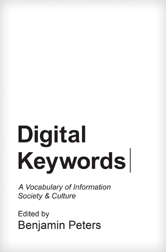
Digital Keywords: A Vocabulary of Information Society and Culture by Benjamin Peters
Publication Date: 2018
Digital Keywords gathers pointed, provocative short essays on more than two dozen keywords by leading and rising digital media scholars from the areas of anthropology, digital humanities, history, political science, philosophy, religious studies, rhetoric, science and technology studies, and sociology. Digital Keywords examines and critiques the rich lexicon animating the emerging field of digital studies.

Publication Date: 2022
Haider and Sundin question what we accept as truth, fact, and knowledge—and how those ideas shape our ability to write, think, and communicate. In an age of information overload, this book digs into what it really means to be media literate and explores how power, perception, and literacy interact in the digital age.
Credo Reference cover 11,000+ reference topics from all major academic subject areas and is a great starting point for research. Entries include images, quotations, audio files, videos, ebooks and full text articles on a variety of topics. In addition to reference topics, Credo includes over 700 academic reference books. Credo's Nursing and Allied Health Collection provides access to 23 current nursing ebooks.
Sources
Marr, Bernard. (2022, July 22). The 4 digital skills everyone will need for the future. Retrieved from https://www.forbes.com/sites/bernardmarr/2022/07/22/the-4-digital-skills-everyone-will-need-for-the-future-of-work/?sh=3d102c0aa7e2
Wamsley, L. (2020, October 13). Your technology Is tracking you. Take these steps for better online privacy. NPR. https://www.npr.org/2020/10/09/922262686/your-technology-is-tracking-you-take-these-steps-for-better-online-privacy
What is fake news? Is it malicious—or just lazy? And what can we do to avoid it? Read below to understand this phenomenon and how you can navigate our changing media landscape.
The End of Traditional Publishing
In the past, information came to us through only a few established, official channels, such as the evening news, the local newspaper, or a traditional publishing house. Information transfer through these methods was slow, as each news interview, article, or book passed through multiple hands in the selection, editing, and distribution process.
By contrast, in today's world of instant communication, information comes to us from an unlimited number of sources. We watch vloggers discuss important topics on TikTok or YouTube, download ebooks directly from the author's webpage, or stream a podcast from our smart phones. Without the traditional publishing process, this information is distributed immediately and often without any oversight. This results in a large amount of misinformation that end users have to sift through on their own.
The Rise of Fake News
While a lot of bad information comes from those with good intentions (but poor quality control), there has also been a rise in malicious actors who spread false information on purpose. They may be doing so for a variety of reasons, from getting people to buy their products to convincing people to vote a different way in an election. Fake news can range from covering a news story in a biased manner to completely inventing information with the intent to influence readers.
SMART Evaluation
As end users of information, what can we do? One helpful tool is the SMART evaluation. While reading, consider the following:
Keep these tips in mind when reviewing any new information, especially when researching for your coursework. Check out additional resources below.
For more tips and sources, check out the South College Library's Fact-Checking: How to Guide Research Guide.
Library Resources
After Truth: Disinformation and the Cost of Fake News
Publication Date: 2020
An HBO documentary on the consequences of disinformation and fake news in the era of social media.
Publication Date: 2020
Publication Date: 2020
Publication Date: 2018
Useful Websites